Learning experiences don't begin with a tool, they begin with an inquiry. We believe that a rigorous Needs Analysis is the cornerstone of successful design. By deeply collaborating with Subject Matter Experts (SMEs) and stakeholders, we work to uncover the true "why" behind every project, identifying the unique challenges of the audience and the specific outcomes required by the context. Only then can we begin mapping out the course. Each case study demonstrates our process of translating complex needs into authentic, accessible, and high-impact learning paths.
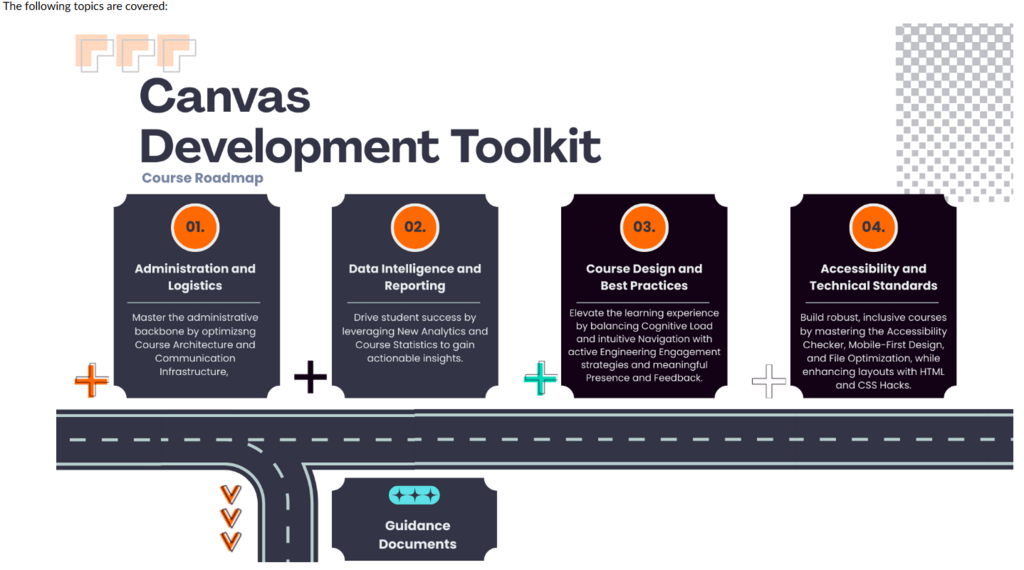
Online Canvas Training Toolkit for Inscape Design College.

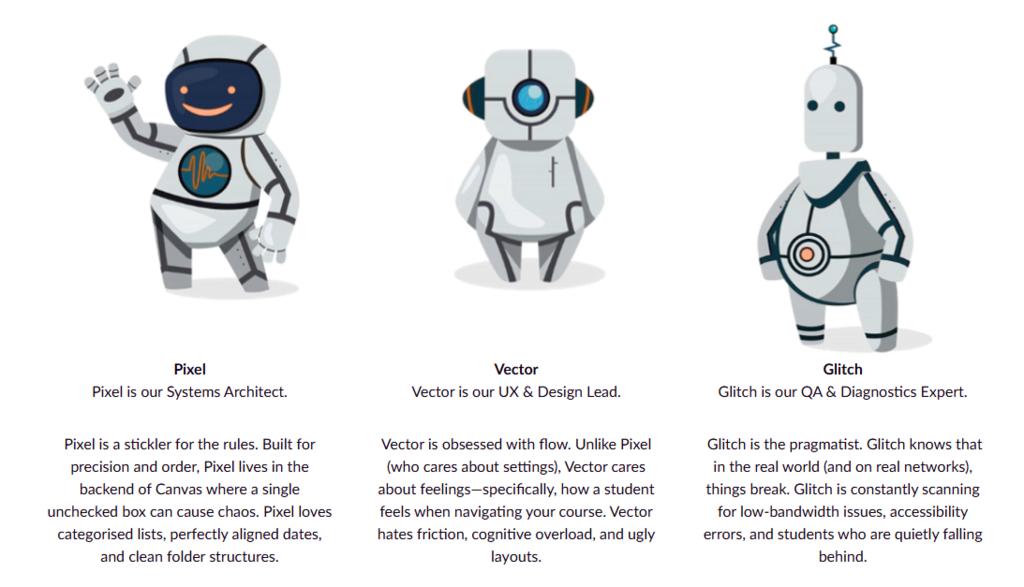
Inscape was implementing Canvas in a phased approach, and from the outset it was clear that the traditional Canvas role definitions were not mapping neatly onto the way Inscape actually worked. Through an extensive discovery process involving multiple stakeholder consultations, it became clear that the boundaries between lecturer, administrator, and content developer roles were blurred. Layered on top of this was the complexity of Inscape's diverse student body, spanning full-time, part-time, online, and hybrid learners, each with their own distinct needs and Canvas configurations. A standard training approach would not do justice to the nuance of their context.
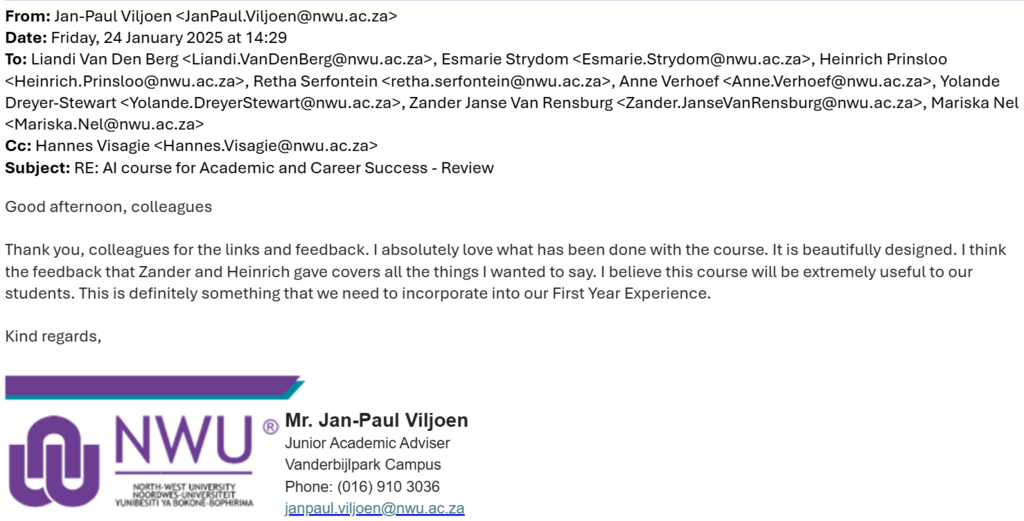
I designed a vibrant, SCORM-compliant learning experience built on Articulate Rise. To ensure high engagement, the course featured two AI-generated avatar tutors, Kaiza and Zenka, who acted as peer-guides through the various "AI Levels". The tutors were included as both static and animated characters. Rather than a static quiz, the course culminated in an authentic artefact: a personalised Career Plan developed through iterative AI prompting and student critique, developed as they worked through the levels, culminating in a tangible tool students could use throughout their University journey.


North West University Compulsory Student "AI for Academic Success Course" developed as a SCORM package. A project by North West University

North West University (NWU) required a compulsory, university-wide course to equip all students with the skills to navigate the rapid integration of AI in Higher Education and the global workforce. The core need was to move beyond "using AI" to teaching responsible, ethical use within the university’s specific AI assessment framework. The challenge lay in creating a high-stakes, mandatory course that felt youthful and engaging rather than purely administrative.
I designed a vibrant, SCORM-compliant learning experience built on Articulate Rise. To ensure high engagement, the course featured two AI-generated avatar tutors, Kaiza and Zenka, who acted as peer-guides through the various "AI Levels". The tutors were included as both static and animated characters. Rather than a static quiz, the course culminated in an authentic artefact: a personalised Career Plan developed through iterative AI prompting and student critique, developed as they worked through the levels, culminating in a tangible tool students could use throughout their University journey.
Please watch the screen recording of an extract from the course.
Incorporated into the iHeed Course Development team, to assist in the production of the Infectious Diseases Programme for medical professionals.
iHeed, an Irish-based medical education provider, required the development of a high-level Postgraduate Diploma for a global audience of busy medical professionals, predominantly across Europe and Asia. The challenge was twofold: incorporating into an established international team and unlike typical ID roles the instructional designer was required to research, source, and synthesise high-quality medical data into a structured learning format which could delivered in a way that respected the limited time of a practising clinician.
I designed multiple modules that shifted the focus from passive reading to active clinical reasoning. The solution centred on "Complex Medical Content Made Accessible" through a case-study-led approach. By integrating instruction directly into realistic patient scenarios, learners could immediately apply theoretical knowledge to clinical practice. The final product was a sleek, professional experience hosted on Storyblok, designed for high-impact, mobile-friendly learning.
Incorporating educational storytelling and learner readiness strategy to help TourAxis (TourCademy) with a strategic business goal.

TourAxis, a corporate leader in global travel, faced a specific recruitment challenge: ensuring that candidates for their intensive face-to-face "bootcamp" truly understood the realities of the industry. The goal was to create a digital "screening course" that served as a prerequisite. It needed to be practical enough to prepare serious candidates, while also acting as a filter to ensure that only those with a genuine interest and aptitude progressed to the expensive in-person training. The content had to appeal to a wide, diverse range of global learners.
I designed a storytelling-driven experience that replaced dry theory with a high-stakes narrative. The course follows the journey of two high-performing characters, Ben and Ava, who come from very different backgrounds but share the same goal of becoming tour leaders. By interweaving their stories throughout the curriculum, learners were forced to navigate real-world situations and make decisions alongside the characters. This approach transformed the learning into a "day-in-the-life" simulation, ensuring that the theory was directly grounded in the vision and expectations of TourAxis.
Watch the screen recording of an extract of the course developed on the LearnWorlds LMS.
Implementing Universal Design for Learning (UDL) by making foundational-level content engaging without compromising its legal SAQA accredited course integrity.

The NWU Unit for Continuing Education (UCE) sought to expand its digital offerings by converting traditional, paper-based study materials into a fully online programme. The primary challenge was the NQF Level 2 designation of the course; the material needed to be highly accessible and interactive for foundational learners while remaining strictly aligned to the version accredited by the South African Qualifications Authority (SAQA). I had to find a way to enhance the learner experience without altering the core content that had already passed regulatory approval.
I developed a high-engagement online programme that maintained 100% content integrity while dramatically reducing the cognitive load for the learner. The solution focused on multimodal delivery, replacing long passages of text with interactive infographics, HTML5 content and AI-powered micro-lectures. By using diverse media, I ensured that the foundational concepts of entrepreneurship were clear, actionable, and suitable for learners in both rural and urban contexts.